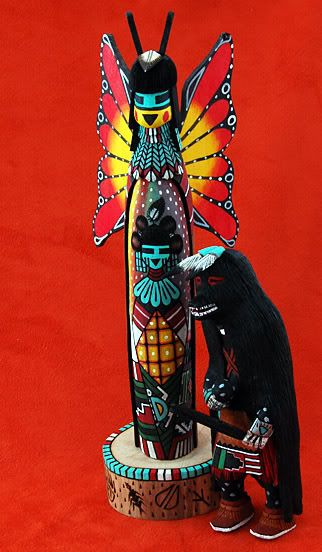
 I'm fond of saying that Hopi jewelry is good by definition. Since the middle ages they have survived in their hostile high desert land that would have decimated other civilizations in short order. I believe their well honed survival skills have lead in part to a discipline that is manifest in the near perfection one sees so consistently in their art, especially their jewelry and Kachinas. The Hopi's are vastly outnumbered by their Navajo brethern thus their products are quite limited when judged by comparison. I'm surprised products we list do not sell as briskly as I would expect given their consistent excellence of quality and rather scant supply. Perhaps it is only a few traders like me, collectors, and the Japanese that have really discovered Hopi jewelry. Even though we have a good supply of Hopi products on hand, I wanted to get in another day of shopping so Sandy and I took off early this morning under clear skies for a day trip to Hopi. We had no trouble finding additional products to market and intereacting with Hopi artisans was once again delightful. Our buying was compete in short order so we decided to stop at the Hopi Cultural Center for some blue corn fry bread based tacos and on exit encountered Kachina maker Lawrence Mahle of Polacca on 1st Mesa. We do not deal in Kachinas for a variety of reasons the two principal ones being that the jewelry business keeps us busy and shipping of Kachinas is not something we want to do. Nonetheless on seeing Mr. Mahle with his well made products, along with his young wife and child, I wanted to support his art and so bought the Healer Bear Kachina you see pictured. He explained the role of the healer bear whose magic healing is derived and delivered from juniper root he gives to chew on. He is also said to answer prayers and Mr. Mahle suggested that we try directing some of our own prayers to the Bear. I walked away feeling quite good about my acquisition of the bear. I had taken only a couple of steps in toward my car when Calvin Pavetea, a Hopi also from Polacca, pulled up in his pickup truck to ask me through his open window to take a look at his butterfly Kachina that he was offering for sale. When he quoted his price, I informed I had just depleted my cash reserves on the Bear. He agreed to take a check. Meanwhile, he explained to Sandy the construction and meaning of our new Butterfly Kachina then he pulled a piece of raw cottonwood root to show her. Hopi Kachinas are widely acknowedged as the best and their carving depends on a source of cottonwood root no longer available on their reservation land. It was just a wondeful day once again out here in the West, I even picked up a piece of jewelry that will be a candidate for find of the year. Stayed tuned for a look at Navajo Cody Hunter's storyteller belt buckle.
 Saturday, January 31, 2009
Another Grand Hopi Buying Trip
I'm fond of saying that Hopi jewelry is good by definition. Since the middle ages they have survived in their hostile high desert land that would have decimated other civilizations in short order. I believe their well honed survival skills have lead in part to a discipline that is manifest in the near perfection one sees so consistently in their art, especially their jewelry and Kachinas. The Hopi's are vastly outnumbered by their Navajo brethern thus their products are quite limited when judged by comparison. I'm surprised products we list do not sell as briskly as I would expect given their consistent excellence of quality and rather scant supply. Perhaps it is only a few traders like me, collectors, and the Japanese that have really discovered Hopi jewelry. Even though we have a good supply of Hopi products on hand, I wanted to get in another day of shopping so Sandy and I took off early this morning under clear skies for a day trip to Hopi. We had no trouble finding additional products to market and intereacting with Hopi artisans was once again delightful. Our buying was compete in short order so we decided to stop at the Hopi Cultural Center for some blue corn fry bread based tacos and on exit encountered Kachina maker Lawrence Mahle of Polacca on 1st Mesa. We do not deal in Kachinas for a variety of reasons the two principal ones being that the jewelry business keeps us busy and shipping of Kachinas is not something we want to do. Nonetheless on seeing Mr. Mahle with his well made products, along with his young wife and child, I wanted to support his art and so bought the Healer Bear Kachina you see pictured. He explained the role of the healer bear whose magic healing is derived and delivered from juniper root he gives to chew on. He is also said to answer prayers and Mr. Mahle suggested that we try directing some of our own prayers to the Bear. I walked away feeling quite good about my acquisition of the bear. I had taken only a couple of steps in toward my car when Calvin Pavetea, a Hopi also from Polacca, pulled up in his pickup truck to ask me through his open window to take a look at his butterfly Kachina that he was offering for sale. When he quoted his price, I informed I had just depleted my cash reserves on the Bear. He agreed to take a check. Meanwhile, he explained to Sandy the construction and meaning of our new Butterfly Kachina then he pulled a piece of raw cottonwood root to show her. Hopi Kachinas are widely acknowedged as the best and their carving depends on a source of cottonwood root no longer available on their reservation land. It was just a wondeful day once again out here in the West, I even picked up a piece of jewelry that will be a candidate for find of the year. Stayed tuned for a look at Navajo Cody Hunter's storyteller belt buckle. 

Sunday, January 11, 2009
Splendid Red Bear Coral Choker
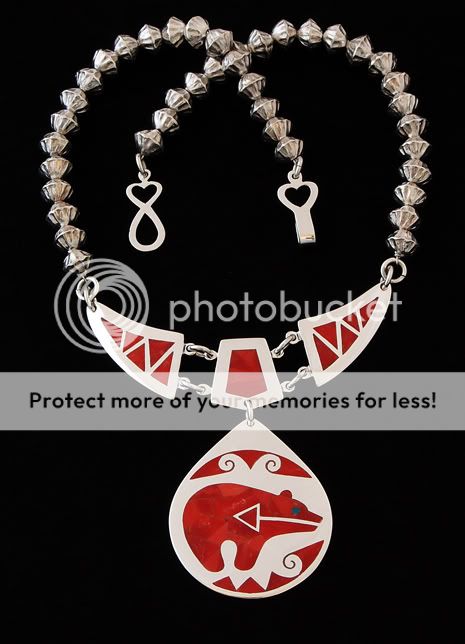
Sandy loves the occsional call from Ruddell Laconsello announcing that he has another ‘show stopper’, one of a kind jewelry piece that he will complete in the next few hours; he then invariably follows, "Will Wilford be interested in it?" I am of course always interested in the Laconsello's work which I regard as the creme' de la creme' of American Indian Jewely. I am particularly interested in unique pieces, one-of-a-kind treasures such as this coral bear choker. It doesn't take long for Ruddel to drive up from Zuni and knock on the door with a satisified artist grin on his face and prize in hand. If you've followed this blog you will recall we bought the couple's prize winning concho belt at this year's Santa Fe Market. Even at $10,000 it did not rest on our inventory shelf longer than a week. The Red Bear Coral Choker master work is only 16” in length, a nice choker size, with the center inlay pendant flanked by two side pieces. Ruddell noted that the design also has a Rococco style embellishment in the clouds and water above and below the bear. The bear's image began with the eye, then silver was laid in for the ‘heartline’ (with red arrow point). The bear was then completed with coordinated shades of red coral pieces. To complete the piece, he used beads which are handmade and fluted. The clasp is the final detail which cleverly compliments the rest of the choker. The large hook and eye clasp each have a heart motif.
We are proud to have acquired this masterwork for sale. Cost $849.
Monday, January 5, 2009
Claudia Peina
 Claudia Peina is a highly celebrated Zuni fetish carver whose finsihed work is quickly absorbed by collectors worldwide. Her masterworks are generally too large to be incorporated into wearable jewelry. The Zuni Maiden shown here stands just over 5 1/2 inches tall. It is carved from antler and inlaid with turquoise, coral, and jet. Note the maiden's coral necklace. Cost: $389.
Saturday, December 13, 2008
Shalako
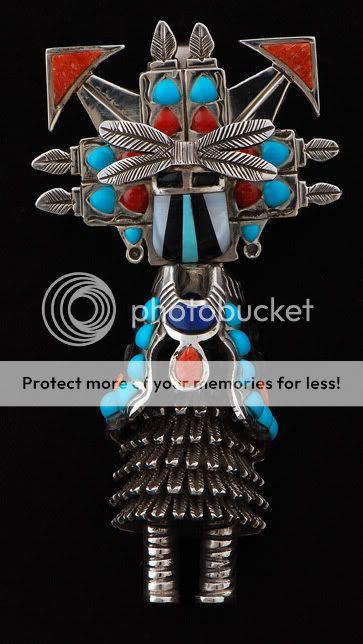
Shalako refers to a series of dances and ceremonies conducted by the Zuni tribe at the Winter Solstice. It is notable in that unlike many other Zuni ceremonies that are closed to outsiders, non-Zuni are often invited. Sandy and I along with our two little children braved Shalako one year. As is typical this time of year at Zuni elevations, it was blistering cold with wind driven snow flurries. We waiting until late in the night to see the actual Shalako. He was quite tall like Bird of Sesame Street. It's only a quick 45 minute drive from our home to Zuni, but the memory of the cruel weather of that first viewing inhibits me from going for a return visit.
For the Zuni, the Shalako ceremonies are the most important event of the year and the Shalako is their most prominent and distinctive Kachina. The Shalako pendant depicted above is the creation of Navajo silversmith Alvin Vandermir. It is a unique piece and should prove to be a valuable collector's luxury unisex neck adornment for man or woman that is bound to be the subject of many a covetous glance. Indeed this one is a treasure to behold. It measures 2 7/8 inches in length and weighs 1.5 ounces. Price $999.00.
Sunday, November 2, 2008
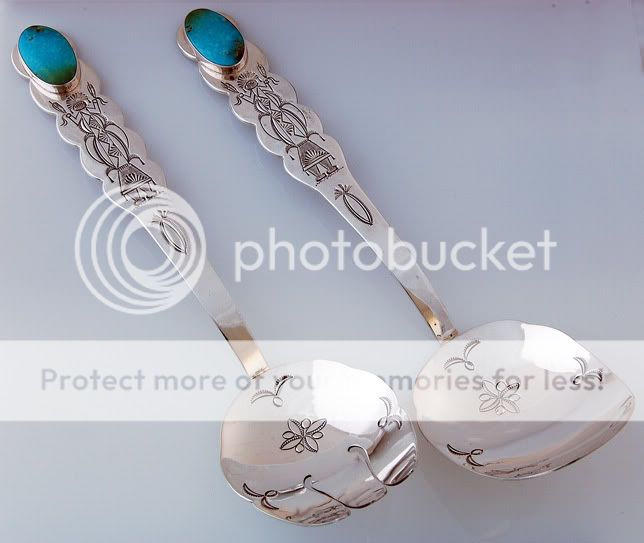
Don Platero's Sterling Silver Salad Set
Wednesday, October 22, 2008
Turkey Season
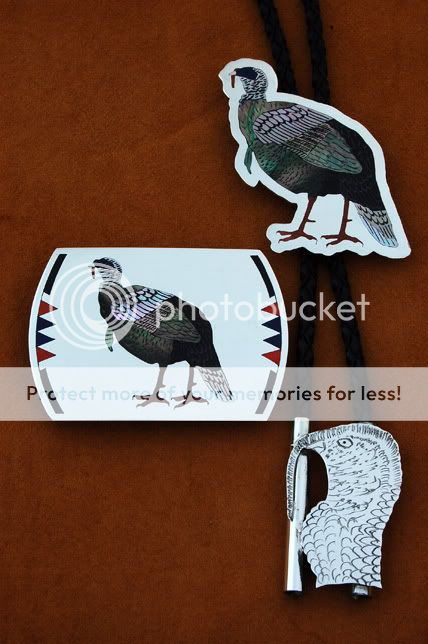 For centuries turkeys have played an important role in the lives of Native Americans. Besides providing a source of meat, their feathers were used to stabilize arrows and decorate ceremonial dress. The spurs on the legs of wild tom turkeys were used as projectiles on arrowheads. There is no definite proof of the 1st Thanksgiving dinner in the autumn of 1621 when some 90 hungry Pilgrims and Native Americans are said to have gathered in grand celebration. Turkey was probably not among the meat dishes served. A first hand account pened by the leader of the colony stated that the food included, ducks, geese, venison, and fish. For omnivores turkey consumption season extension extends through Christmas in large part thanks to Charles Dickens' The Christmas Story.
Our beloved Wild Turkey as depicted by the Zuni artist Dale Edaakie in the buckle /bolo set as shown here nearly followed the DoDo bird to extinction, but thanks to convervation repopulation programs it survives in relative abundance in all states except Alaska.
The Zuni often celebrate birds in their art although I rarely see the turkey incorporated in their jewelry. This sterling silver creation set with multiple stones and in etched in fine creative detal should be worn with pride and should appreciate reliably in value in the years ahead. Cost $769.00.
Thursday, October 16, 2008
Halloween Spiders
 Spider Woman is one of the important deities of the Navajo. She is most honored for saving the ancient Navajo people from free roaming monsters. Spider Rock is one of the most awesome sights in the world. It stands in dignity some 800 ft above the canyon floor in Arizona's Canyon de Chelly National Park, which is part of the Navajo Nation. I do not know what inspires E. Spencer to make these sterling spiders, but I suspect his motives are ancient in origin and not from their adopted Halloween Night which is vigorously celebrated throughout Indian land. The sterling silver pin/pendant spiders you see in the image here range in price from $15 to $69. They go well especially with high fashion.
Thursday, October 9, 2008
Dale Edaakie's Bird Bolo and Buckles
 Dale Edaakie's Zuni inlay work is simply outstanding. To learn more about him refer to his biography at the American Masters of Stone website. The buckles measure 3 x 2 1/8 inch. Each sterling silver buckle bolo set sells for $729.
Thursday, October 2, 2008
Paul J. Begay's Tobacco Flask
 His hallmark is "PJ Begay." I've run across his fine work frequently and I've occasionally bought and sold some of his bracelets. He once worked for the late Harry Morgan and was no doubt influenced by Harry's technic and old style revival work. Even though Mr. Begay lives in Gallup, we've not crossed paths, but I hope to meet him in the near future now that he has risen to the top tier of my list of outstanding Navajo smiths. My interest in his work was heightened early this week when I was shown the canteen picured above. Such containers were historically created to be used as tobacco flasks, but the market for those is severly diminished, but a good whisky flask still has great market appeal. It is generally only the best of smiths who are willing to craft canteens. This canteen holds 140ml and measures approximately 2 3/4 inches in diameter, 1 1/4 inches in thickness, and is crowned by a #8 Nevada mine turquoise gem stone. Price $1000.
Monday, September 29, 2008
Andrea Lonjose Shirley
 Andrea Lonjose Shirley's lapidary work has no equal that I'm aware of. A distinctive feature of Zuni jewelry is exacting fit that often goes beyond what one expects of mere mortal hands. The casual observer might mistake the piece shown as a masterful example of a small Champlevé painting. Champlevé is an enamel technique in which troughs are carved into the surface of a metal framework then filled with a vitreous enamel. The piece is then fired until the enamel melts then polished after cooling. The "Zuni Ball Eye Kachina" shown is inlaid on sterling silver with mother of pearl, acoma jet, coral, and sleeping beauty turquoise. On close-up inspection there is no mistaking it for a Champlevé piece. It stands 3.5 inches tall and can be worn as pin or pendant. Cost = $599.00.
Thursday, September 25, 2008
Silver Spurs
 In the days of chivalry spurs and the metal from which they were made were a mark of rank. Hence the expression "to earn your spurs." Today they are a standard piece of cowboy equipment; designs vary widely. I've found only three Native American Silversmiths willing to rise to the challenge of crafting spurs. The first was the late Harry Morgan. I located a pair of his excellent spurs in a showcase at an area dealer shortly after starting this business. When I asked about price, I was clearly told--not for sale. This year, much to my delight, I found two pair entered into competition at the 87th Gallup Intertribal Ceremony. Both were dazzling. One pair was done by Gary Reeves (Navajo), the other by his equally talented brother Sunshine Reeves. I passed on the opportunity to buy, somewhat to my regret which was reversed today when I found and bought the winning blue ribbon pair by Sunshine Reeves. At an appraisal price of $6000, these sterling silver blue ribbon winning spurs may indeed be hard to earn.
Thursday, September 18, 2008
Stanley Parker's Traditional Old Style Navajo Jewelry

Stanley Parker (1952..) was born and raised on the Navajo reservation in the shadow of the great Shiprock located in the 4 corners region of New Mexico. Unlike many of his contemporary competitors who had the early advantage of childhood home schooling in the fine art of silversmithing, he learned his skill later in life. As a young man, he began working in the electronics industry soldering circuit boards, but he was subsequently drawn to silvermithing as a career after watching others work in the medium. He told me that his experience soldering electronic circuits facilitated his transition to working with silver. I was very impressed with his work I first discovered at a wholesale distributor in Albuquerque. I met him two years running at the Santa Fe Indian Market, but it wasn't until last week that he called me and asked to visit me here in Gallup. Two things about Stanley's work that really stand out are: 1) master silversmithing and 2) choice of natural turquoise. His silver work is so precise that it looks machine made, only on careful inspection in most cases can one see "maker-marks." Stanley is very careful in his choice of stones and finding satisfactory "cabachons" for mounting is his biggest production frustration. He used to cut his own from raw materials, but now finds he doesn't have the time to cut and polish. His fine work understandably commands high prices. The bracelet above featuring the rectangle of King Manassas turquoise is $435.00.
Monday, September 8, 2008
Zuni Canteen
 The ability to craft a good canteen is the mark of an accomplished silversmith, an art among the Navajo that goes back to around 1880. It was in that year that Washington Matthews, a Ft. Wingate, NM army officer, published an account of silversmithing in which a silver canteen was described and illustrated. In that era they were popular among the soldiers as tobacco flasks. The great modern Navajo canteens I've seen among the Navajo were crafted by Harry Morgan, Sunshine Reeves, and Gary Reeves. The above mini-canteen was made by Carlton Jamon of Zuni. The canteen shown measures only 3 inches from top to bottom and about 3/4 of an inch in thickness. Thus, it is clearly designed for use as a perfume carrier as they were popularly used by Navajo women in the early 20th century. They would buy perfume at the trading post then put their pleasant fragrance in one of these small canteens to carry securely tied to the bottom of a strands of beads. The above sterling silver canteen is accented with the 12K gold petroglyphic hand, sleeping beauty turquoise, and malachite. The silver surface is both textured and shinning. I was able to buy only this one piece, but Mr. Jamon appeared anxious to make more for me, so I hope to keep them on hand in EBay store. Price $700.
Saturday, September 6, 2008
Tohono O'odam Jewelry
 I had the privilege of living with my young family among the Tohono O'odam (formerly Papago) Indians on their reservation in the Sonoran Desert of Southern Arizona for two years in a decade past. It was there that I met Nick, a full blooded Papago, who became one of the best friends I've ever had. The friendship came about when Nick refused to sell me a horse; but interestingly, he had no hesitation in loaning me one indefinitely. So it was that I spent many hours mounted high in the saddle of my stallion named Gu-Achi. Nick would frequently invite me on wild horse round-ups with his Tohono O'odam buddies and he's take me out to hunt javelina, deer, quail, or to round up beef on the hoof for slaughter. Hardly a week passed that Nick and I missed adverturing in the desert mountains or home on the range in that beautiful, but hostile desert land where the stately Saguaro cactus, lifespan up to 200 years, weigh in at thousands of pounds each, and grow 40 ft upward to skies that are rarely cloudy all day. The Papago are noted for their remarkable tightweave, decorative baskets made from native grasses and Devil's claw. Their mini-baskets are woven and shaped from horsehair. Sandy and I collected quite a few baskets, but silverwork was scarce and we acquired only two pieces I showed in a blog entry several months ago. And so it is that we learned first hand to appreciate the people and land of the Tohono O'odam.
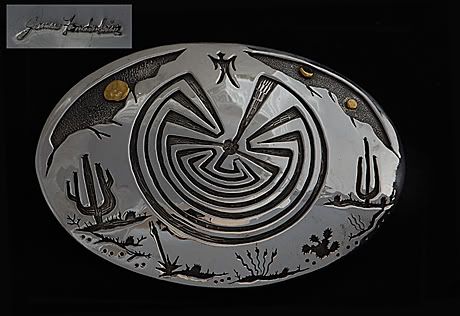
The James Fendenheim buckle shown above is a byproduct of another highlight (that of meeting James) at this year's Santa Fe Indian Market. I first encountered James at his booth where we talked silver and he told me how to get in touch with the other notable Tohono O'odam jewelry maker. He was not interested in selling wholesale to me so I could market his work worldwide, but he was happy to sell me the buckle above at show's end to feature in this blog. If you would like to see more of James' fine quality work click here. The above Western style buckle retails for $900 dollars, it is accented with 18K gold and features, the saguaro cactus and the Man (James calls the figure Star Man) in the Maze, both are very commonly depicted in Tohono O'odam art.
Wednesday, September 3, 2008
Gene Billie's Sterling Silver Sculptures
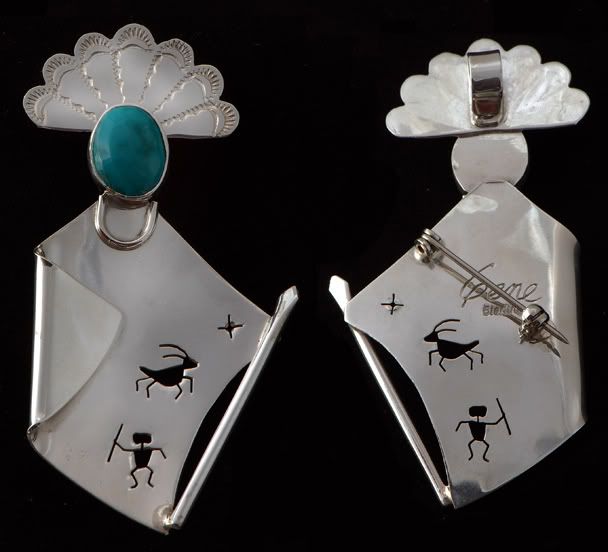 I did not have long to spend at Gene Billie's (Navajo) booth at the recent Santa Fe Indian Market. It was buzzing with folks admiring his table top size silver sculptures. I was intrigued with a small corner of his table where he was exhibiting small jewelry derivates of his larger works. as you see in the image of the pin/pendant here. The petroglyph figures are small cut outs. This piece is entitled Native Spirit's Celebration. It measures 1.5 x 2.75 inches.
Subscribe to:
Posts (Atom)